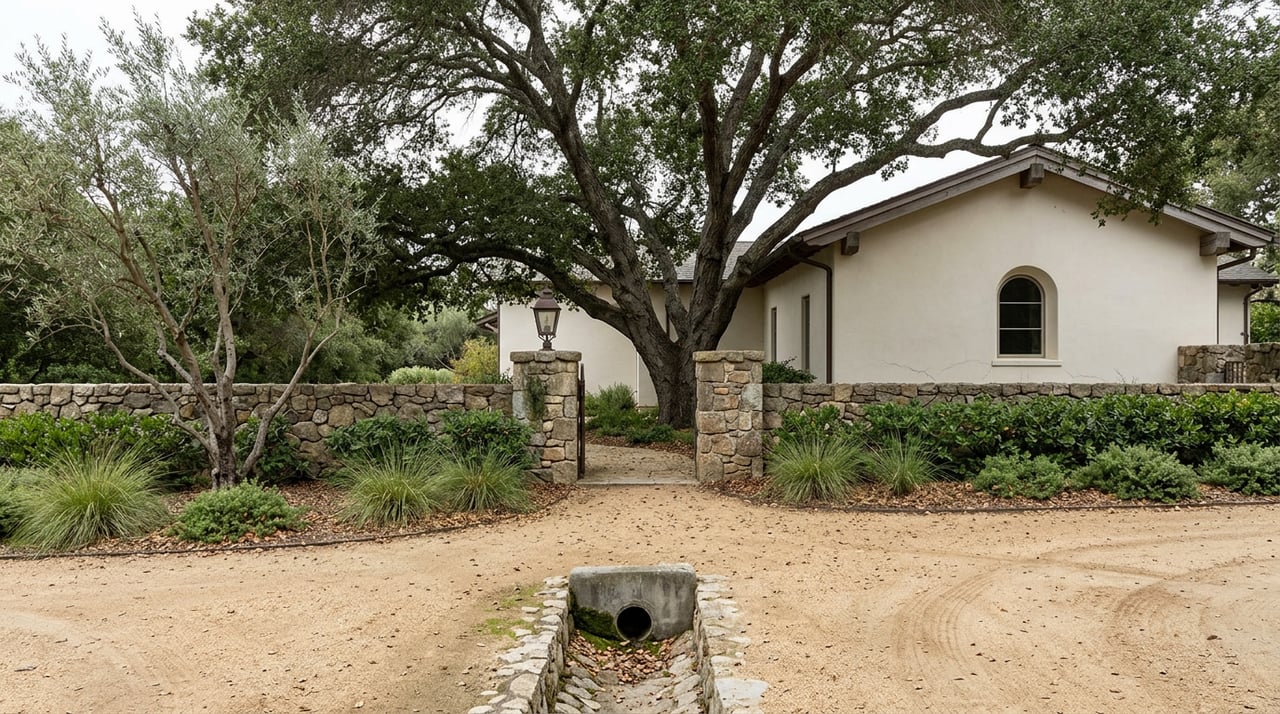
Road access is one detail to understand when considering a five-acre parcel on the Santa Rosa Plateau. S&K Grading notes that almost every road in La Cresta is private. Private-road obligations can extend beyond an HOA line item, so buyers should understand the specific arrangement before removing contingencies.
An important detail is that two houses on what looks like the same road can carry two completely different maintenance obligations. The HOA resale package you request tells you a lot about the association's finances. It does not tell you which category your particular driveway falls into. That distinction is worth understanding before you write an offer.
Two road systems, one plateau
The Santa Rosa Plateau is made up of several distinct communities, La Cresta, La Cresta Highlands, The Trails, Santa Rosa West, Tenaja, and Meadow Oaks, each with its own parcel pattern and, in many cases, its own governing association and recorded covenants. Within La Cresta proper, the La Cresta Property Owners Association was formed in 1969 and incorporated in 1989 to handle maintenance, drainage, slope easements, and fire retreat areas across roughly 5,878 acres and 887 parcels, most of them five-acre minimums.
The association maintains about 26 miles of what it considers the original primary road network, the roads that were part of the plateau when the community was laid out.
So the honest answer to "who maintains the road" in La Cresta depends on the specific arrangement. Whether the association, the fronting owners, or the county is responsible for a given parcel is not something you can determine by driving the property or reading the listing description.
What nine miles of cul-de-sac actually costs
An engineering-scope estimate circulated to LCPOA members priced out repair options for roughly nine miles of cul-de-sac roads on the plateau. A cosmetic repair approach came in at the low end of the millions of dollars. Bringing those same roads up to a county-comparable standard, matching the asphalt thickness, width, and turnaround radius of the primary system, landed in the mid-teens of millions.
| Repair scope | Estimated range for ~9 miles of cul-de-sacs |
|---|---|
| Cosmetic patch and resurface | Low millions |
| County-standard reconstruction | Mid-teens of millions |
That spread is the whole lesson in one table. Scope drives cost far more than distance does, and the same nine miles of pavement can be a modest line item or a genuinely serious liability depending on which standard gets chosen. If that cost sits with an 887-parcel association, it's an assessment everyone absorbs together. If it sits with the six or eight owners fronting one orphaned spur, because no recorded agreement ever assigned it to the association, the per-owner math looks nothing like the association-wide number.
The fire code trigger nobody budgets for
There's a second reason this question can surface at the worst possible moment, when you're mid-permit for new construction rather than mid-escrow on a purchase. Riverside County Fire Department's access guideline requires that a spur road or private driveway accessed off a cul-de-sac be no more than 150 feet long unless an approved turnaround has been added within that distance. If you're planning a barn, a guest house, or any addition that extends your driveway past that threshold, fire access compliance can force a conversation about upgrading a private spur that nobody has touched in decades. That's a construction-timeline problem as much as a maintenance-cost problem, and it's worth raising with the Fire Prevention Bureau early rather than discovering it partway through plan check.
What the resale package tells you, and what it doesn't
California's Davis-Stirling Act requires an association to produce a defined set of documents to a prospective buyer on written request: governing documents, current budget, reserve study, a statement of any pending or approved special assessments, and litigation disclosures. The association has ten days from a written request to deliver them, and once the buyer has the complete package, there's a statutory review window, typically three days after personal delivery or five after mailing, during which the buyer can cancel without penalty if something in the documents changes the picture.
That's a genuinely useful right, and it's worth exercising on every plateau purchase. It's also not a complete answer to the private road question. The resale package tells you whether the association overall is financially healthy. It does not itemize which specific spur serves your specific parcel, whether that spur has a recorded maintenance easement, or whether it falls inside the association's 26-mile maintained network or outside it. That distinction lives in the tract map referenced in the CC&Rs and in road committee records, not in the standard disclosure bundle.
The question that actually protects you isn't "does the HOA cover roads." It's "does the HOA cover this road, the one in front of this driveway." Those are different questions with different answers, and only one of them shows up in the standard packet.
Before you remove contingencies
A short list, worth working through with your agent and your escrow officer before any contingency period closes:
- Request the full resale package under Civil Code 4525, and read the reserve study, not just the budget summary.
- Pull the tract map referenced in the CC&Rs to see whether your specific frontage was part of the original maintained network.
- Ask the association or its road committee directly whether any assessments or vendor bids are pending for the road serving your parcel.
- Confirm in writing whether a recorded maintenance easement or agreement exists for that spur.
- If you're planning to build or expand, check fire access compliance with the Riverside County Fire Prevention Bureau before finalizing plans, not after.
None of this is a reason to avoid La Cresta. It's a reason to ask a more specific question than most buyers know to ask, and to ask it early enough that the answer can still change your decision.
A few questions worth asking directly
Does every community on the Santa Rosa Plateau work the same way? No. La Cresta, La Cresta Highlands, The Trails, Santa Rosa West, Tenaja, and Meadow Oaks each carry their own recorded covenants and, in some cases, separate associations. A road-maintenance answer for one community doesn't transfer to the next.
If my agent says the road is "private but maintained," is that enough? It's a start, not an answer. Maintained by whom, under what agreement, and funded from which budget line are the follow-up questions that actually matter for your cost exposure.
Can this affect insurance, not just maintenance cost? Yes. Whether a road is HOA-owned common area or a shared private easement affects who typically carries liability insurance on it, which is one more reason to get the answer in writing rather than assuming it from the CC&Rs alone.
Acreage on the plateau rewards buyers who ask precise questions early. If you're evaluating a La Cresta property and want to walk through exactly what its road status is before you write an offer, or you're preparing to sell and want that answer ready before a buyer asks, Andrea Lynn Duncan works this terrain daily. Call for a private consultation before your contingency clock starts running.
This article is general information, not legal, tax or financial advice. Consult a qualified professional about your situation.