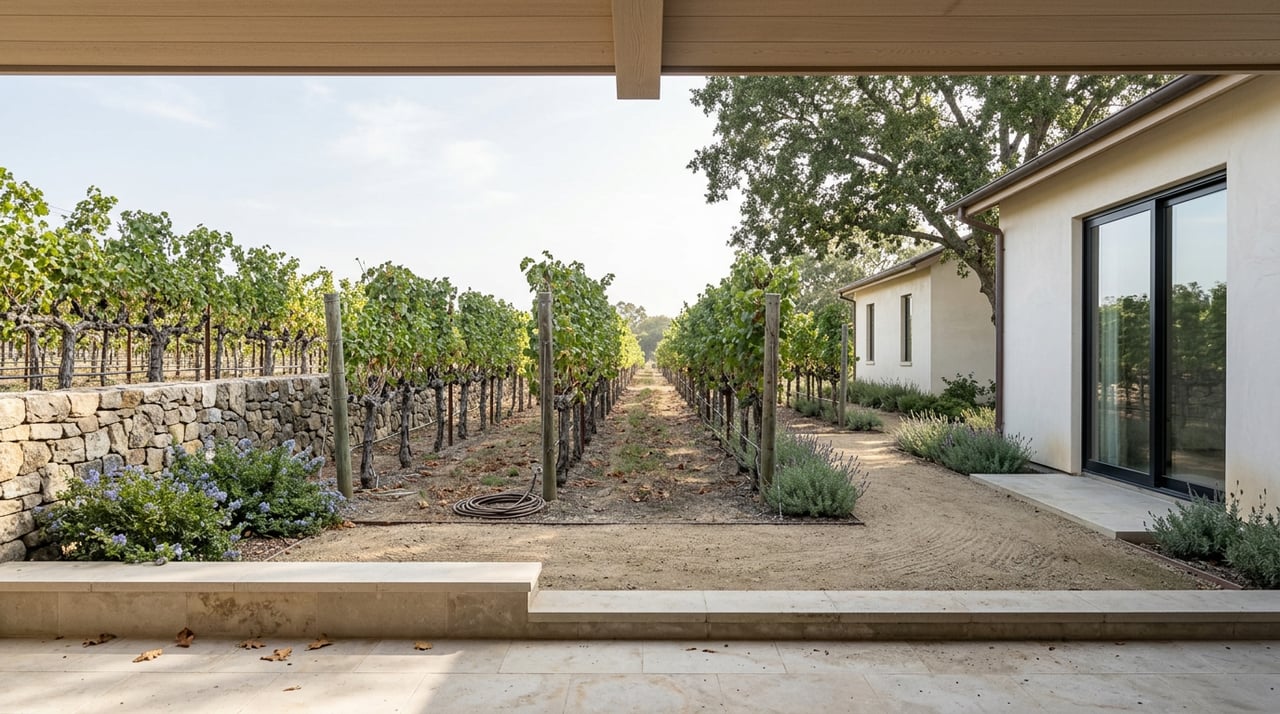
Drive west from Rancho California Road into De Luz and the land looks the same. Same oak-studded hills, same seasonal creeks, same long views toward the Santa Margarita. Some of the De Luz parcels even have producing avocado groves and existing vineyard rows. Yet list two comparable five-acre parcels side by side, one inside the Temecula Valley Wine Country boundary and one just outside it in De Luz, and the Wine Country parcel routinely commands 20 to 35 percent more. The soil didn't change. The view didn't change. What changed is a line on a zoning map that most buyers never think to ask about until an agent or an escrow officer mentions it.
That line is the Temecula Valley Wine Country Specific Plan, sometimes called SP-7, and it is the actual mechanism behind the region's land premium. Not the vines. Not the sunsets. The legal right to operate a commercial tasting room on the property.
The zoning line nobody puts in the listing photos
Riverside County's land use ordinance carves Wine Country into three distinct zoning districts: Wine Country Winery (WC-W), Wine Country Equestrian (WC-E), and Wine Country Residential (WC-R). Only parcels inside the Winery district, and a smaller Winery Existing designation for properties already operating under older entitlements, can legally pour tastings, sell wine commercially, or host events without going back to the county for additional permits. Land outside that boundary, no matter how much it looks like Wine Country from the road, defaults to standard agricultural zoning that allows you to grow grapes but not to charge someone to taste them.
That distinction shows up directly in early 2026 sale prices. Estate homes on five-plus acres along the Rancho California Road corridor, inside the SP-7 boundary, traded between $1.1 million and $2.8 million during that window. Agricultural parcels of similar size and improvement level in Hemet and San Jacinto, both still within Riverside County but outside any wine-specific entitlement, sold for $450,000 to $950,000. Recent vineyard listings across the Temecula market averaged roughly $2.75 million, with land alone pricing near $148,000 per acre.
Here's what that comparison actually shows.
| Location | Zoning status | Typical 2026 price range |
|---|---|---|
| Rancho California Road corridor (Wine Country) | SP-7 entitled, WC-W or WC-E | $1.1M–$2.8M for 5+ acre estates |
| De Luz | Outside SP-7, standard agricultural | 20–35% below comparable Wine Country parcels |
| Hemet / San Jacinto | Outside SP-7, standard agricultural | $450K–$950K for comparable acreage |
The gap between the first row and the other two is not explained by soil quality, elevation, or proximity to San Diego and Orange County, since De Luz sits inside that same commute radius. It is explained by what the zoning legally permits a future owner to do with the land.
What the entitlement actually buys you
An SP-7 designation is not a blanket permission slip. The ordinance sets real conditions on what a Winery-zoned parcel has to do to keep that status. A property seeking full commercial winery use must have 50 percent of its vineyard planted before the county issues a building permit for the winery structure, and 75 percent planted before final inspection or certificate of occupancy, whichever comes first. Once a winery is operating under a post-2016 entitlement, at least half the wine it sells has to be produced on that same site rather than trucked in and rebottled. County code also sets a minimum subdivision lot size of ten gross acres in the Winery zone, which is one reason true Wine Country estate parcels rarely come smaller than that.
The county's own stated purpose for the policy area is narrower than it might sound. The ordinance describes the goal as protecting the area's ability to "preserve the wine-making atmosphere, estate living, equestrian life-style" while limiting incompatible development pressure. In practice that means the entitlement is tied to active agricultural use, not simply to sitting inside a pretty boundary. A buyer purchasing raw SP-7 land still has to plant, still has to produce, and still has to maintain the vineyard set-aside if the parcel is part of a wine country clustered subdivision, where those production acres are held in perpetuity through the HOA or a county service area.
That is worth sitting with before assuming the zoning line alone is the whole story. It is the doorway, not the finished building. But it is a doorway that De Luz land, however beautiful, simply does not have.
Why the entitlement has an economy behind it
The reason buyers pay for that doorway becomes clearer when you look at what has grown up around it. A business analysis published in April 2026 counted 145 active commercial businesses inside the Wine Country footprint, anchored by 49 wineries, 29 lodging properties, and 15 wedding venues. For every winery in the area, roughly two additional businesses, hotels, tour operators, restaurants, cluster around it. Old Town Temecula, fifteen minutes away, functions as a completely different economic cluster of its own, built around 247 businesses led by restaurants and independent shops rather than tasting rooms.
That distinction matters for anyone comparing acreage prices across the valley. A Wine Country parcel isn't priced against raw farmland elsewhere in the Inland Empire. It's priced against a functioning hospitality district with lodging density, event infrastructure, and tourism demand already built out around it, all of which only exists there because the zoning allows commercial wine operations in the first place. Take away the entitlement and you take away the reason that infrastructure grew there instead of two miles down the road.
Two frictions that show up after you've already fallen for the entitlement
Buyers who understand the zoning premium still run into two specific problems once they're in escrow on Wine Country acreage. Both are avoidable if you know to look for them early.
The Williamson Act clock you inherit from a stranger. Some Wine Country and surrounding agricultural parcels are enrolled in California's Williamson Act, which lowers property tax assessments in exchange for a commitment to keep the land in agricultural use. The part buyers miss is that a non-renewal notice filed against the contract runs with the land, not with the person who filed it. If a prior owner started a non-renewal four years ago, the buyer inherits whatever years remain on that countdown, along with the tax and use implications that come with it. This has to be verified directly against the Riverside County Assessor's records and disclosed through title and escrow. Relying on a seller's verbal account of the contract status is not enough.
The well test that isn't the well test you think you're getting. Standard California residential purchase agreements require a water quality test on private wells, checking for things like coliform bacteria and nitrates. They do not automatically require a well yield test, which measures how many gallons per minute the well sustains over time. For a house with normal residential demand, three to five gallons per minute is typically the lender minimum. For a property with vineyard irrigation, livestock, or an orchard, the real number needed is often ten to twenty gallons per minute or more. A buyer can pass the standard water quality test, close escrow, and still discover the well can't support the vines already planted on the property. Adding an explicit flow test contingency, typically $400 to $900, before removing contingencies is the difference between finding that problem in week two of escrow or finding it the first August after closing.
A few questions Wine Country buyers ask once they understand the zoning
Does buying outside the SP-7 boundary mean I can never add a tasting room later? Not necessarily, but it means starting from standard agricultural zoning and pursuing additional county entitlements rather than inheriting existing commercial winery rights with the land.
Is De Luz a worse investment because it sits outside the boundary? Not automatically. De Luz appeals to buyers who want the acreage, privacy, and agricultural character without the commercial-use framework, often at a meaningfully lower entry price for comparable land.
Can I verify a specific parcel's zoning myself before making an offer? Yes. Riverside County's planning department maintains the Ordinance 348 zoning text and GIS parcel lookup tools, and any serious offer on Wine Country or De Luz acreage should confirm the actual zoning designation rather than relying on a listing description.
If you're comparing acreage across this line, whether it's a vineyard-ready parcel inside the SP-7 boundary or a quieter estate site in De Luz, the zoning designation should be the first thing you confirm, not the last. Andrea Lynn Duncan has spent more than two decades working these corridors and can walk you through what a specific parcel's entitlement actually allows before you write an offer. Call me for a private consultation.