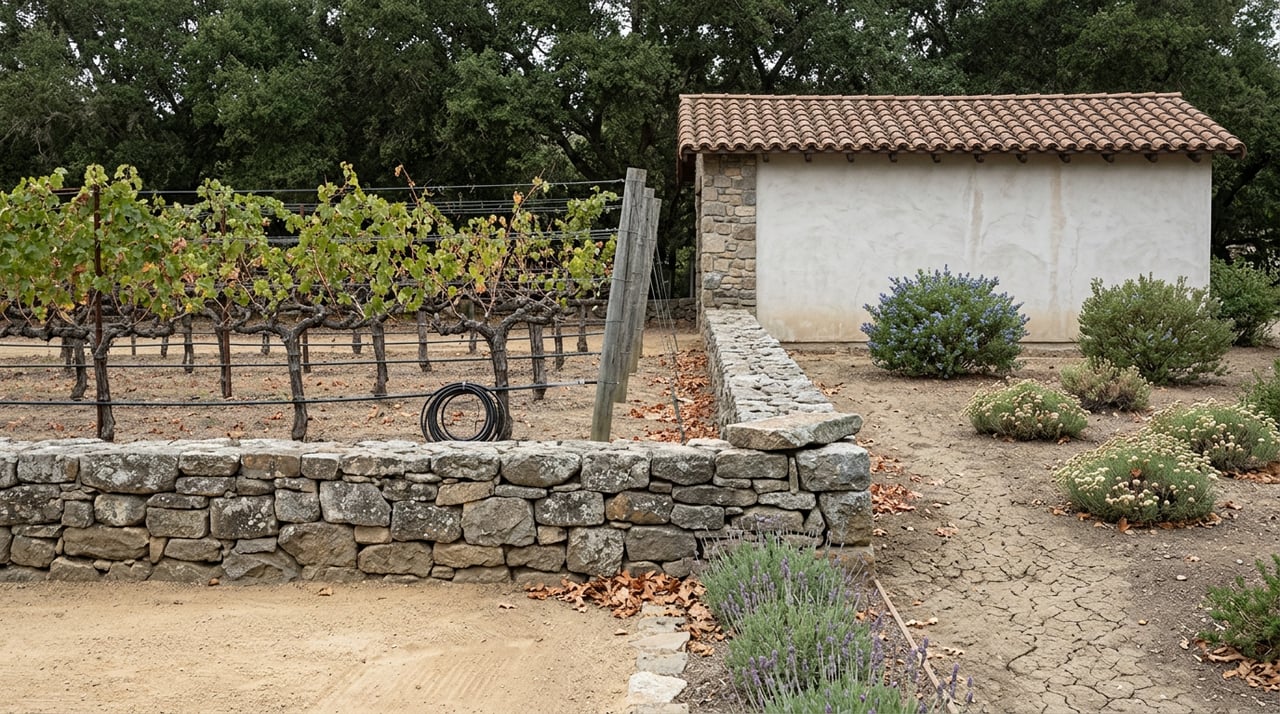
A parcel on Rancho California Road can carry two separate permissions to build a winery, and they don't expire on the same clock. One is the zoning entitlement that lets the county call the land Wine Country in the first place: the SP-7 overlay, the WC-W or WC-WE designation, the right to eventually pour wine for paying guests. The other is a property tax contract that has nothing to do with what you're allowed to build and everything to do with whether the county will let you build it yet.
Most people who write offers on entitled acreage in Temecula Wine Country only check the first one. The second one is why a parcel that looks development-ready on paper can still take years to actually clear.
What a 1974 signature has to do with a 2026 escrow
Riverside County's own case file on what is now the Monarch Winery project lays out a timeline worth sitting with. The land sits inside Rancho California Agricultural Preserve No. 1, a preserve the county established on February 10, 1969. A Land Conservation Contract, the formal name for a Williamson Act agreement, was executed on that parcel in 1974. Decades later, a subsequent owner filed a Notice of Nonrenewal, recorded with the county in 2006. Under the Act's rules, that filing didn't cancel the contract outright. It started a nine-year countdown. The contract didn't fully expire until December 31, 2015.
Even after expiration, the parcel wasn't done. The formal removal of that acreage from the county's Agricultural Preserve map, a separate administrative step called a diminishment, went through the Comprehensive Agricultural Preserve Technical Advisory Committee in 2019 and wasn't approved by the Board of Supervisors until Resolution No. 2021-203. From signature to a cleared map, the process spanned 47 years.
None of that had anything to do with whether the parcel was zoned for a winery. It has been zoned Agriculture within the Wine Country Policy Area's Winery District the entire time. The delay was a tax contract, not a land use designation, and it ran on its own schedule regardless of what the zoning map said.
Two different questions, two different offices
The entitlement question and the tax contract question live in different places, get answered by different county staff, and get fixed in different ways. It's worth keeping them separate before you write an offer.
| Zoning entitlement (SP-7 / WC-W / WC-WE) | Williamson Act contract | |
|---|---|---|
| What it governs | Whether a tasting room, event space, or winery use is legally permitted on the parcel | Whether the county taxes the land at agricultural income value instead of market value |
| Where to check | Riverside County Planning zoning maps and the parcel's plot plan history | The Assessor's parcel record, flagged with an "AP" class code, plus the preliminary title report |
| How it's resolved | A use permit, plot plan, or change of zone application | A filed Notice of Nonrenewal (nine-year phase-out) or a cancellation with a penalty |
| Who it binds | The land, regardless of tax status | The land, regardless of zoning, and it transfers to the next owner |
If we covered the first column already when we wrote about why an acre in Temecula Wine Country costs more than an acre a mile away in De Luz, this is the column that post didn't get to. The entitlement is what makes the land expensive. The contract is what can make the timeline expensive too.
The nine-year clock doesn't reset when the land changes hands
Here's the part that catches buyers mid-transaction. If a parcel is under an active Williamson Act contract and a prior owner already filed a Notice of Nonrenewal, that nine-year phase-out period keeps running when the property sells. A buyer who closes on a parcel with five years left on someone else's non-renewal notice inherits those five years. The clock doesn't start over just because the name on the deed changed.
The alternative to waiting out a non-renewal is cancellation, and the state built that path to be difficult on purpose. A landowner can petition for cancellation, but it requires findings that cancellation serves the public interest, and it comes with a fee, historically set at 12.5 percent of the land's unrestricted current fair market value. On a multi-acre Wine Country parcel, that is not a rounding error. It's a number that belongs in the deal math before the contingency period closes, not after.
There's also a use restriction that has nothing to do with timing. Under Riverside County's Compatible Use Ordinance, land currently under a Williamson Act contract cannot be used for indoor or mixed-light cannabis cultivation, regardless of what the underlying zoning would otherwise allow. It's a reminder that an active contract can foreclose specific uses outright, not just delay them.
Meanwhile, the tax benefit that makes owners hold onto these contracts in the first place is real. A Department of Conservation review found that Williamson Act enrollment has historically saved participating landowners between 20 and 75 percent in annual property tax liability, and in that same study, one in three surveyed Williamson Act farmers and ranchers said they would no longer own their land without it. That's the trade a seller who's stayed enrolled has been making for years, and it's exactly why the contract doesn't just quietly go away when a buyer with different plans shows up.
What to check before you write the offer, not after
If you're seriously evaluating acreage inside the Wine Country Policy Area, whether you want a working vineyard, a future tasting room, or simply a large parcel with agricultural flexibility, a few checks belong early in your process rather than buried in escrow paperwork.
- Pull the Assessor's parcel record and look for the "AP" class code. That single flag tells you whether the parcel is currently under a Land Conservation Contract.
- Ask your title company directly whether the preliminary title report shows an active Williamson Act contract or a recorded Notice of Nonrenewal, and if so, how many years remain on the phase-out.
- Don't rely on a listing description alone. Phrases like "wine country property" or "vineyard-ready" describe character, not legal or tax status.
- If a non-renewal is already in motion, get the recording date. That tells you the actual year the restriction lifts, not the year you close.
- If no non-renewal has been filed and your plans require the land free of the contract soon, understand that filing one starts a nine-year clock, and cancellation carries a real financial cost.
For sellers, the same information works in reverse. If your parcel carries an active contract or a partially completed non-renewal, disclosing that status clearly and early, alongside the zoning and use-permit history we've written about when preparing a Wine Country estate for sale, keeps a serious buyer from walking away mid-escrow when their own title search turns it up.
A few questions worth asking directly
Does every parcel in Temecula Wine Country carry a Williamson Act contract? No. Enrollment is voluntary, and many parcels within the Wine Country Policy Area were never placed under a contract, or were enrolled and later fully released. The Assessor's class code is the fastest way to check any specific parcel.
If I buy land with an active contract, can I still farm it or keep it in vineyard while I wait out a non-renewal? Generally yes. The contract restricts the land to agricultural and other compatible uses, which typically includes the vineyard, orchard, or grazing use already in place. What it restricts is converting the land to non-agricultural development before the phase-out completes.
Does the contract affect what the zoning otherwise allows? It can. Even where SP-7 zoning and a WC-W or WC-WE designation permit winery or event uses, an active Williamson Act contract layers its own restriction on top, and certain uses, like indoor cannabis cultivation, are barred outright under the county's compatible use rules regardless of zoning.
Acreage in this part of Riverside County rewards buyers and sellers who read past the zoning map. If you're evaluating a parcel in Temecula Wine Country and want someone who checks both layers before you're deep into escrow, Andrea Lynn Duncan offers the kind of detail-focused, locally grounded guidance this land actually requires. Call for a private consultation before you write the offer, not after the title report comes back with a surprise.