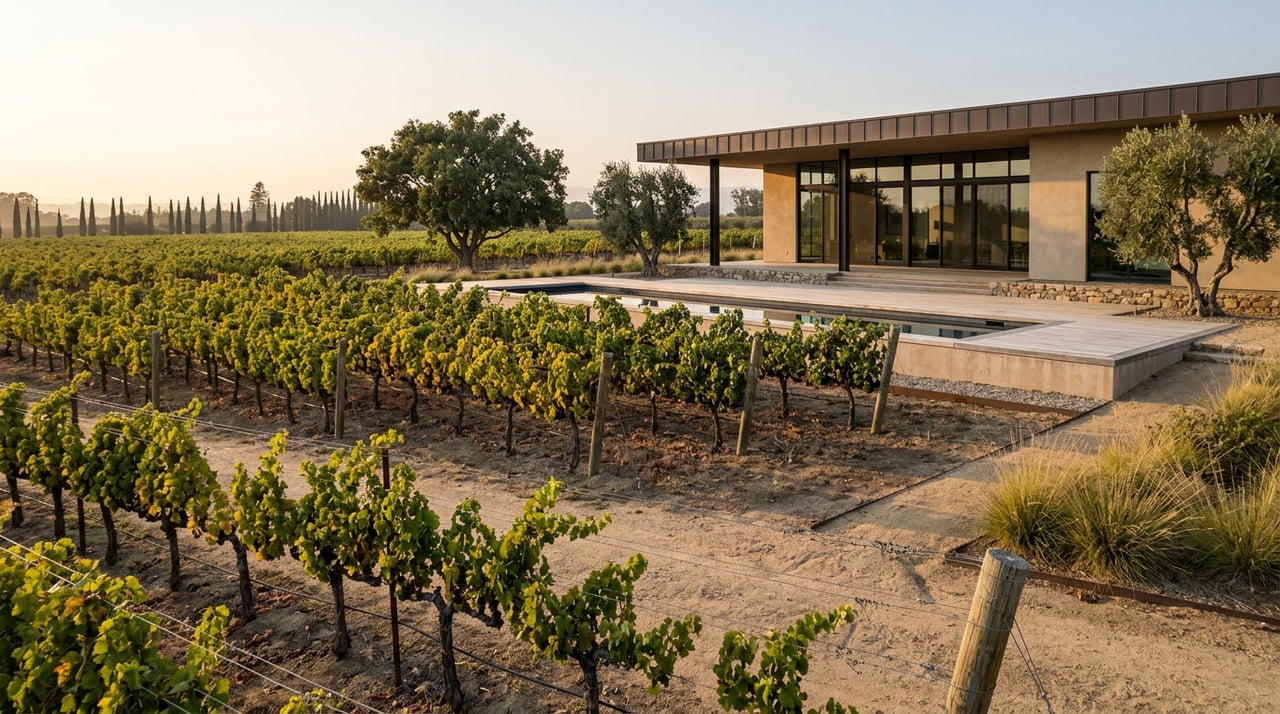
A buyer looking at a tired ten-acre avocado grove off Rancho California Road usually runs the same math. Land cost, plus site prep, plus vines, trellising, and drip irrigation, plus three years of carrying costs before the first commercial harvest. They price the parcel assuming they will cover the entire bill themselves.
What they often do not know is that a water district has been quietly offering to cover part of it for years.
Rancho California Water District runs a program called CropSWAP, short for Sustainable Water for Agricultural Production. Since 2016, it has paid growers in its service area to rip out high water use crops like avocados and replant with something the district would rather see in the ground: wine grapes. The program has since expanded into a regional partnership covering Fallbrook Public Utility District, Rainbow Municipal Water District, Valley Center Municipal Water District, and the City of Oceanside. Anyone evaluating a "vineyard-ready" parcel in Wine Country should know this program exists, and should know that whether it is actually funding conversions right now is a question with a real answer, not an assumption.
The math the district is actually solving
The reason avocados keep losing ground to grapevines in this part of Riverside County has less to do with romance and more to do with a spreadsheet at the water district. Avocado orchards farmed at commercial density can require up to six acre-feet of water per acre per year. Wine grapes can be grown on as little as two acre-feet. That is a three-to-one difference on the district's most expensive input, in a service area that imports a majority of its water from the Metropolitan Water District of Southern California.
In an ACWA report, Bill Wilson, a Rancho Water board member who owned vineyards himself, described the thinking behind the program plainly:
"What if we can incentivize them with grants to rip out the avocados and other higher water using crops, and we'd help them pay for the replanting? They would lose a year or so of production, but they wouldn't go so far in the negative that they'd never be able to catch back up."
That is the trade the district is making. It accepts a short-term payout to a grower in exchange for a permanent reduction in that property's annual water draw. For a buyer standing in front of a grove, this means the "vineyard-ready" premium attached to a parcel is not purely a story about zoning or lifestyle. Part of it is a water district actively subsidizing the transition from one crop to another, because the district benefits every time it happens.
What the incentive actually pays
The headline number in CropSWAP's crop conversion category is up to $22,500 per acre for a full avocado-to-vinifera conversion, a figure that reflects both plant replacement and irrigation system upgrades. Earlier versions of the program paid up to $15,000 per acre for similar work. Growers who are not converting an entire block can still tap smaller incentives for water efficiency upgrades.
| Project type | Typical incentive |
|---|---|
| Avocado to wine grape crop conversion | Up to $22,500 per acre |
| Crop rejuvenation | Up to $4,500 per acre |
| Cover crop adoption | Up to $100 per acre |
| Per-participant cap | $50,000 in any 12-month period |
A minimum acreage applies, and the program will not fund the replacement of a dead or neglected orchard. The crop being removed has to have been irrigated to commercial production standards in the twelve months before conversion, which means the incentive rewards active working groves, not abandoned ones.
The scale is bigger than one grove
This is not a boutique pilot that touched a handful of parcels. The original Rancho Water program completed 29 crop conversion projects covering 156 acres, cutting water use by 558 acre-feet in the first year alone, with avocado replacement accounting for roughly a third of all project types. When the program expanded regionally, the partnership had provided nearly $4 million in incentives across hundreds of acres, saving more than 800 acre-feet of water per year.
Put those acres on a map of the AVA and a pattern emerges. Some of the "vineyard-ready" parcels a buyer sees advertised along Rancho California Road or De Portola Road did not start as raw land waiting for someone's dream. They started as avocado groves that a water district paid a grower to convert, sometimes years before the property ever hit the market. If you have wondered why an established vineyard commands more than a bare parcel with the same SP-7 zoning entitlement, part of the answer is that someone else already absorbed a chunk of the conversion cost, and the current price reflects that sunk investment rather than a discount you can renegotiate.
The catch buyers need to check before they underwrite anything
Here is where the story gets less tidy than "free money for growers." CropSWAP funding does not sit open indefinitely. It moves in rounds, tied to state and federal grant cycles, and it has closed to new applicants more than once. Rainbow Water's own program page notes that its allocation of regional funding reached capacity within roughly a year of opening, and that as of 2025 new project submissions were being waitlisted pending additional funding.
That detail matters enormously if you are the one doing the math on an avocado grove. If your underwriting assumes you can apply for a CropSWAP incentive to help fund a conversion after closing, you need to confirm the program is currently accepting applications in your specific water district's territory before you rely on that number. A waitlisted program does not disqualify a property from ever converting. It just means the subsidy is not guaranteed on your timeline, and a conversion plan built around an incentive that has not been secured is a plan built on a number you do not actually control.
If you are evaluating a working grove with vineyard potential, a few questions are worth asking before you write an offer:
- Is the seller's water account currently classified as agricultural or ag-residential with Rancho California Water District, or with whichever regional partner serves the parcel? Only accounts with that classification are eligible.
- Has the seller already applied for or received a CropSWAP incentive on this property? If so, ask what conditions or reporting requirements might carry forward.
- Is the Regional CropSWAP program currently open for new applications, or is it waitlisted? This changes month to month, and the program administrator can confirm status directly.
- What is the property's documented water use history? The incentive amount is partly calculated from a participant's prior water use, so a seller without clean records may complicate your ability to apply after purchase.
- If you plan to convert acreage yourself, does the existing crop meet the program's requirement of having been irrigated to commercial production standards within the past twelve months? An orchard that has been neglected may not qualify even if it is technically still avocados.
None of this replaces the due diligence you would already do on a well or a water right. It sits alongside it. If you have not yet worked through the well question that Wine Country buyers tend to ask backward, the CropSWAP conversation is a natural extension of that same homework, since both come down to what a parcel's water situation actually costs you over time rather than what it looks like on the day you tour it.
A few quick answers
Does the incentive transfer to a new owner, or does the seller keep it if they already converted before selling? The incentive is paid to whoever holds the water account and completes the approved conversion. If a seller converted the crop years ago and already collected the payment, that money is theirs. A buyer purchasing an already-converted vineyard is buying the finished result, not an open incentive.
Can a buyer apply for CropSWAP after closing on a grove? Yes, as long as the buyer becomes the qualifying agricultural water account holder and the program is currently accepting applications in that territory. Confirm current enrollment status directly with the program administrator rather than assuming availability based on older program materials.
Does every avocado grove in Wine Country qualify? No. The crop has to be actively irrigated at commercial production levels, the property has to sit within a participating water district's service area, and minimum acreage requirements apply. A neglected or underwatered orchard may not meet the bar.
The premium attached to a "vineyard-ready" parcel in Temecula Wine Country has always had more moving parts than the listing photo suggests. Zoning entitlement is one piece. Water economics, and a specific water district willing to pay for the transition, is another. If you are weighing an existing grove against a bare parcel or an already-planted vineyard, the numbers above are the ones worth running before you decide what the land is actually worth to you.
If you are looking at acreage in this part of the valley and want a second set of eyes on the water side of the deal, Andrea Lynn Duncan has spent more than two decades working these parcels and can walk through what a specific property's water history and conversion potential actually mean for your offer. Call me for a private consultation.
This article is general information, not legal, tax or financial advice. Consult a qualified professional about your situation.